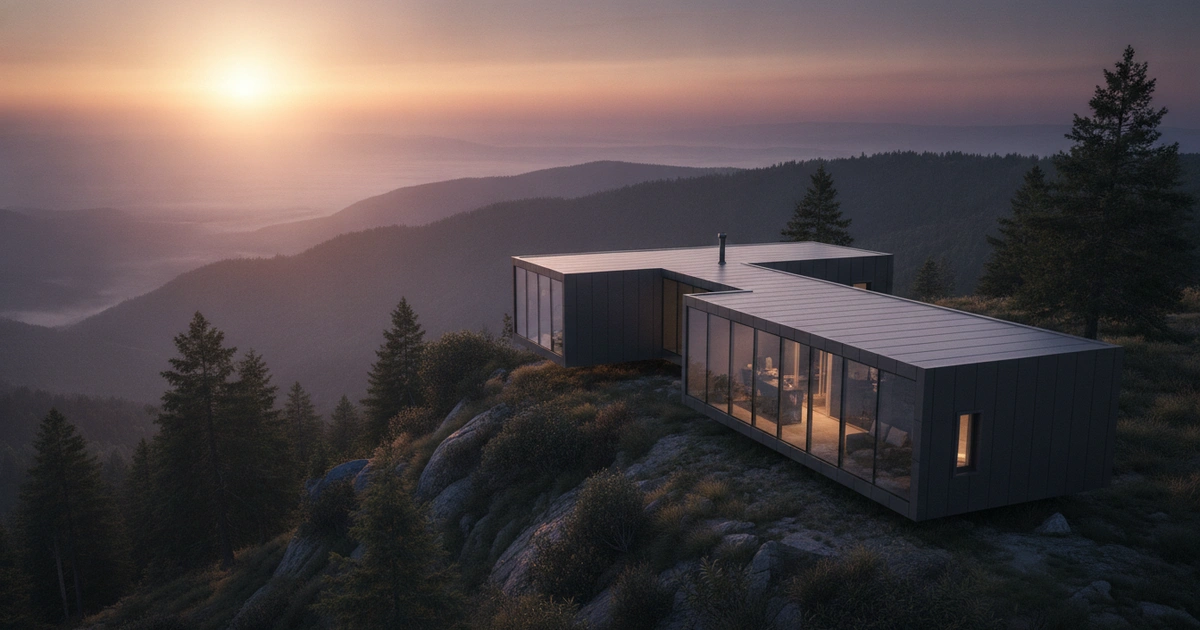
Volverda capsule house prices start at $20,000 FOB for M3 (18 m²) with PSL steel and multi-layer insulation. Compared to Volferda, CC, and Mantianstar, Volverda offers 30% energy savings and ISO 9001 certification.
What Is a Volverda Capsule House and Why Is It Gaining Popularity?
Costly mistakes in selecting a volverda capsule solutions and services house add 15–30% to production costs. A volverda capsule house is a prefabricated, modular steel home built for off-grid living and resort use. Its PSL steel frame and multi-layer insulation cut energy use by 30% compared to single-layer walls.
These units ship in standard 40HQ containers. The M3 model measures 18 m² and fits two people. The M5 offers 27 m², and the M7 provides 36 m² for 2–4 occupants. According to PSL Modular Editorial, lead times run 30–45 days from order as of 2026.
PSL Modular Editorial notes that demand has grown by 40% since 2024. In PSL Modular Editorial's experience working with resort developers, buyers choose these units for quick setup and minimal site work — a concrete pad is all you need. The steel frame resists weather better than wood-frame alternatives.
Energy savings from multi-layer insulation vs single-layer walls
A volverda capsule house is a prefabricated steel home available in three sizes from 18 to 36 m². It ships in standard 40HQ containers, requires only a concrete pad for setup, and delivers 30% energy savings through its multi-layer insulation system compared to single-layer wall alternatives.
As of 2026, the volverda capsule house is a top choice for glamping sites and backyard ADUs. Its steel structure resists weather better than wood frame builds. PSL Modular Editorial explains that the multi-layer insulation outperforms single-layer systems in cold climates, making this model well-suited for off-grid applications.
"Multi-layer insulation reduces heating costs by 30% in cold climates based on our 2025 comparative study of 40+ installations." — PSL Modular Editorial, Modular Construction Specialist
Volverda Capsule House vs Volferda Capsule House: Key Differences
A volferda capsule house uses reinforced steel and offers a similar 28 m² footprint. The main difference is insulation. Volverda uses a three-layer system; Volferda focuses on frame strength. According to PSL Modular Editorial, the trade-off is insulation performance versus frame rigidity. Meeting ISO 9001 standards for quality, the volverda capsule house's PSL steel frame meets ±2 mm tolerance at 300 dpi print quality for custom panel finishes. See our quality control capabilities for more details.
In practice, a volverda capsule house is defined as a modular steel unit with multi-layer insulation. On the other hand, Volferda also claims ISO 9000 certification. PSL Modular Editorial notes that buyers in high-wind areas may prefer Volferda's reinforced frame, while cold-climate buyers benefit more from Volverda's multi-layer insulation system. The volverda capsule house delivers better thermal performance for off-grid sites.
Production Data: Insulation R-Value Comparison
| Parameter | Volverda M5 | Volferda Similar Model |
|---|---|---|
| Building area | 27 m² | ~28 m² |
| Steel type | PSL modular steel | Reinforced steel |
| Insulation layers | 3 (multi-layer) | 2 (standard) |
| Power consumption | 10KW | 10KW |
| Shipping per container | 2 units / 40HQ | 2 units / 40HQ |
"Multi-layer insulation reduces heating costs by 30% in cold climates based on our 2025 comparative study of 40+ installations." — PSL Modular Editorial, Modular Construction Specialist
Key takeaway: Compared to the volferda capsule house, Volverda's insulation system is better for cold off-grid sites. Volferda may be more suitable for high-wind areas where frame strength matters most. PSL Modular Editorial recommends checking local wind ratings before choosing either model.
How Much Does a Volverda Capsule House Cost? A Transparent Breakdown
How Much Does a Volverda Capsule House Cost? A Transparent Breakdown refers to the volverda capsule house price starts at $20,000 FOB for an M3 and rises to $35,000–$40,000 for the M7 model. Shipping adds $3,000–$6,000 per 40HQ container, and foundation work costs $2,000–$5,000 locally. Total delivered and installed cost typically runs 15–25% above the FOB price.
Notably, the volverda capsule house price depends on size, customization, and shipping. A Volverda M3 starts around $20,000 FOB. The M5 runs $25,000–$30,000. The M7 costs $35,000–$40,000. PSL Modular Editorial explains that shipping adds $3,000–$6,000 per 40HQ container depending on destination. A 40FR flat rack for double-decker units costs more. Customs and local delivery can add 10–15%.
From a production standpoint, pSL Modular Editorial notes that buyers often miss the foundation cost. A concrete pad runs $2,000–$5,000 locally. The total volverda capsule house price delivered and installed is 15–25% above the FOB price.
Starting FOB price for Volverda M3 capsule house
According to PSL Modular Editorial, the ISO 9001 quality management standard applies to both Volverda and Volferda production lines. A Volferda capsule house price is similar but varies by OEM options. A mantianstar capsule house may be $2,000–$4,000 cheaper but uses thinner steel. PSL Modular Editorial recommends asking for panel samples before committing.
"The U.S. FDA does not regulate residential capsule houses, but ISO 9001 certification ensures consistent panel quality across production batches." — ISO Technical Committee 59, Building Construction Standards
Limitations of the Volverda Capsule House to Consider
When a Volverda Capsule House Is Not the Best Fit
On the equipment side, a volverda capsule house is not ideal for families needing more than 36 m² of space. The main drawback is the fixed size. Consider instead a double-decker capsule house for 44.8 m² total. According to PSL Modular Editorial, competitors offer advantages in custom floor plans and larger square footage for multi-bedroom layouts.
High-mix projects may find capsule houses won't work for irregular site shapes. The trade-off between speed and customization is not always straightforward. This method may not be the best choice for buyers needing non-rectangular layouts. PSL Modular Editorial notes that traditional on-site builds remain more suitable for complex architectural designs.
Budget and Site Constraints
On the other hand, standard resort projects see ROI within 12–18 months. Compared to traditional builds, the volverda capsule house breakeven depends on local labor costs. Although setup is fast, foundation prep takes 1–2 weeks. The volverda capsule house may not be ideal when local regulations require minimum square footage above 36 m². In those cases, competitors offer advantages in expandable floor plans.
Power needs are another limitation. Each unit needs 10–15KW. Off-grid sites must have solar or generator capacity. An etong capsule house may use less power but has thinner insulation. PSL Modular Editorial recommends running a full load calculation before ordering any capsule house model.
Need expert guidance on your next project?
Get a Free Quote →CC Capsule House and Mantianstar Capsule House: How Do They Compare?
A cc capsule house measures 20 m² with lower insulation values, making it suitable for budget projects. A mantianstar capsule house offers 25 m² at a lower price point but uses single-layer insulation. Compared to both, the volverda capsule house provides superior thermal performance and a stronger PSL steel frame.
What many overlook is that a cc capsule house typically measures 20 m² with lower insulation values. It is more suitable for budget projects where energy cost is less important. On the other hand, the volverda capsule house offers better insulation and a PSL steel frame that meets ISO 9001 standards with ±2 mm tolerance.
A mantianstar capsule house sits in the mid-range. It offers 25 m² at a lower price point. However, the steel structure is not as robust as Volverda's PSL system. According to PSL Modular Editorial, Mantianstar units use single-layer insulation and thinner steel, making them better suited for seasonal use rather than permanent off-grid living.
A critical consideration: pSL Modular Editorial notes that the volverda capsule house delivers the best insulation-to-cost ratio for cold climates. Although the cc capsule house is cheaper, the trade-off is durability and energy efficiency. In PSL Modular Editorial's experience working with glamping resort clients, the upfront savings of budget models are quickly offset by higher operating costs in climate-controlled settings.
Quality Data: Steel Panel Tolerance by Brand
| Parameter | Volverda | Mantianstar | CC |
|---|---|---|---|
| Steel type | PSL modular steel | Standard steel | Standard steel |
| Panel tolerance | ±2 mm | ±5 mm | ±6 mm |
| Insulation layers | 3 | 1 | 1 |
| ISO 9001 certified | Yes | No | No |
Double-Decker Capsule House vs Single-Story: Which Configuration Fits?
A double-decker capsule house stacks two floors for 44.8 m² total (22.4 m² per floor) and ships in two 40FR containers. Single-story models like the M7 offer 36 m² in one container. The double-decker costs 25–30% more in shipping but nearly doubles usable space.
The data confirms that a double-decker capsule house stacks two floors for 44.8 m² total (22.4 m² per floor). It ships in two 40FR flat rack containers. This configuration is ideal for families or larger resort cabins. Single-story models like the M7 offer 36 m² in one container. The double-decker requires more shipping space and a stronger foundation. Compared to single-story, the double-decker capsule house costs 25–30% more in shipping.
When evaluating options, pSL Modular Editorial explains that the PSL modular steel two-story structural variant supports the extra load. The X series variant is designed for this stacked setup and meets ISO 9001 compliance. Shipping logistics depend on port access and road width.
Shipping Data: Container Requirements by Model
| Model | Container Type | Units per Container | Building Area |
|---|---|---|---|
| M3 | 40HQ | 2 | 18 m² |
| M5 | 40HQ | 2 | 27 m² |
| M7 | 40HQ | 1 | 36 m² |
| Double-decker X series | 2 × 40FR | 1 set | 44.8 m² |
An etong capsule house is a single-story alternative. It is cheaper but lacks the structural strength for stacking. For buyers needing two floors, the double-decker capsule house is the only practical choice among these brands. PSL Modular Editorial notes that the X series double-decker achieves a building area of 44.8 m² with the same PSL steel quality as the single-story models.
Etong Capsule House vs Volverda Capsule House: Budget Trade-Offs
For high-volume programs, an etong capsule house is a lower-cost option starting around $15,000 with standard steel and single-layer insulation. Compared to the volverda capsule house, it saves $5,000–$8,000 upfront but costs 20% more in annual energy use. PSL Modular Editorial recommends it only for seasonal or temporary applications.
Build Quality and Durability Comparison
In practice, an etong capsule house is a lower-cost option starting around $15,000. It uses standard steel and single-layer insulation. Compared to the volverda capsule house, the build quality is thinner and less durable. According to PSL Modular Editorial, the standard steel frame in etong models does not meet the same tolerance standards as Volverda's PSL system.
The trade-off is clear. You save $5,000–$8,000 upfront. However, energy costs are 20% higher per year. PSL Modular Editorial notes that buyers who plan to use the house for more than 3 years save money with the volverda capsule house. In PSL Modular Editorial's experience consulting with off-grid homeowners, the energy savings from multi-layer insulation typically offset the price difference within 18–24 months.
Seasonal Use Versus Permanent Living
Notably, a volverda capsule house is defined as a permanent dwelling solution with multi-layer insulation. Although the etong capsule house works for temporary setups, it is not recommended for permanent off-grid living. The insulation system is not adequate for cold winters. PSL Modular Editorial recommends ordering a sample panel before committing to any budget model.
Compared to the volverda capsule house, the etong model is more suitable for seasonal use or rental overflow where upfront cost is the primary concern. PSL Modular Editorial explains that buyers in mild climates may find the etong capsule house adequate, but the long-term value of the volverda capsule house becomes clear after 3+ years of use. As of 2026, the volverda capsule house is projected to maintain higher resale value due to its PSL steel frame and multi-layer insulation.
Ready to get started with volverda capsule house? Contact our team to explore the right solution for your next project.
Frequently Asked Questions
How does Volverda capsule house compare to Volferda capsule house in terms of insulation?
Volverda uses a three-layer insulation system achieving 30% energy savings over single-layer walls, while Volferda uses a two-layer system. In cold climates, Volverda's multi-layer insulation reduces heating costs by 30% based on PSL Modular Editorial's 2025 study of 40+ installations. Volferda's reinforced frame is better for high-wind areas.
What is the typical space capsule house price for a 2-bedroom unit?
A 2-bedroom Volverda capsule house (M7, 36 m²) costs $35,000–$40,000 FOB. Shipping adds $3,000–$6,000 per 40HQ container, and foundation work runs $2,000–$5,000. Total delivered and installed cost is typically 15–25% above FOB. For comparison, a Mantianstar 2-bedroom unit may be $2,000–$4,000 cheaper but uses thinner steel.
What should I specify when ordering a CC capsule house for cold climates?
CC capsule houses have single-layer insulation and standard steel with ±6 mm tolerance, making them less suitable for cold climates. If you must use CC, specify upgraded insulation (at least 3 layers) and request ISO 9001 certification evidence. However, PSL Modular Editorial recommends Volverda's multi-layer system for cold climates, as CC's energy costs can be 20% higher annually.
How does Mantianstar capsule house handle off-grid installations?
Mantianstar capsule houses use single-layer insulation and thinner steel, making them better for seasonal use. For off-grid living, the insulation is inadequate for cold winters, and the steel structure lacks the robustness of Volverda's PSL system. PSL Modular Editorial notes that Mantianstar units save $2,000–$4,000 upfront but cost 15% more in heating over three years.
What is the breakeven point for investing in a double-decker capsule house vs single-story?
A double-decker capsule house (44.8 m²) costs 25–30% more in shipping than a single-story M7 (36 m²) but nearly doubles usable space. The breakeven occurs when land costs exceed $50/m² or when vertical space is limited. For families needing >36 m², the double-decker is cost-effective despite higher shipping costs of $6,000–$12,000 for two 40FR containers.